Presumed Ocular Histoplasmosis Syndrome
Learn about presumed ocular histoplasmosis syndrome, including symptoms, causes, diagnosis, risk factors, and treatment options to help protect central vision.
Overview
Presumed ocular histoplasmosis syndrome, often called POHS, is an eye condition linked to prior exposure to histoplasmosis, a fungal infection that most commonly affects the lungs. In some people, changes can later appear in the retina, the light-sensitive tissue at the back of the eye. Many people never know they were exposed to histoplasmosis, and many people with POHS have no symptoms in the early stages. The condition becomes more concerning when abnormal blood vessels begin to grow under the retina and threaten central vision. Regular dilated eye exams are important, especially for patients who have lived in areas where histoplasmosis is more common.
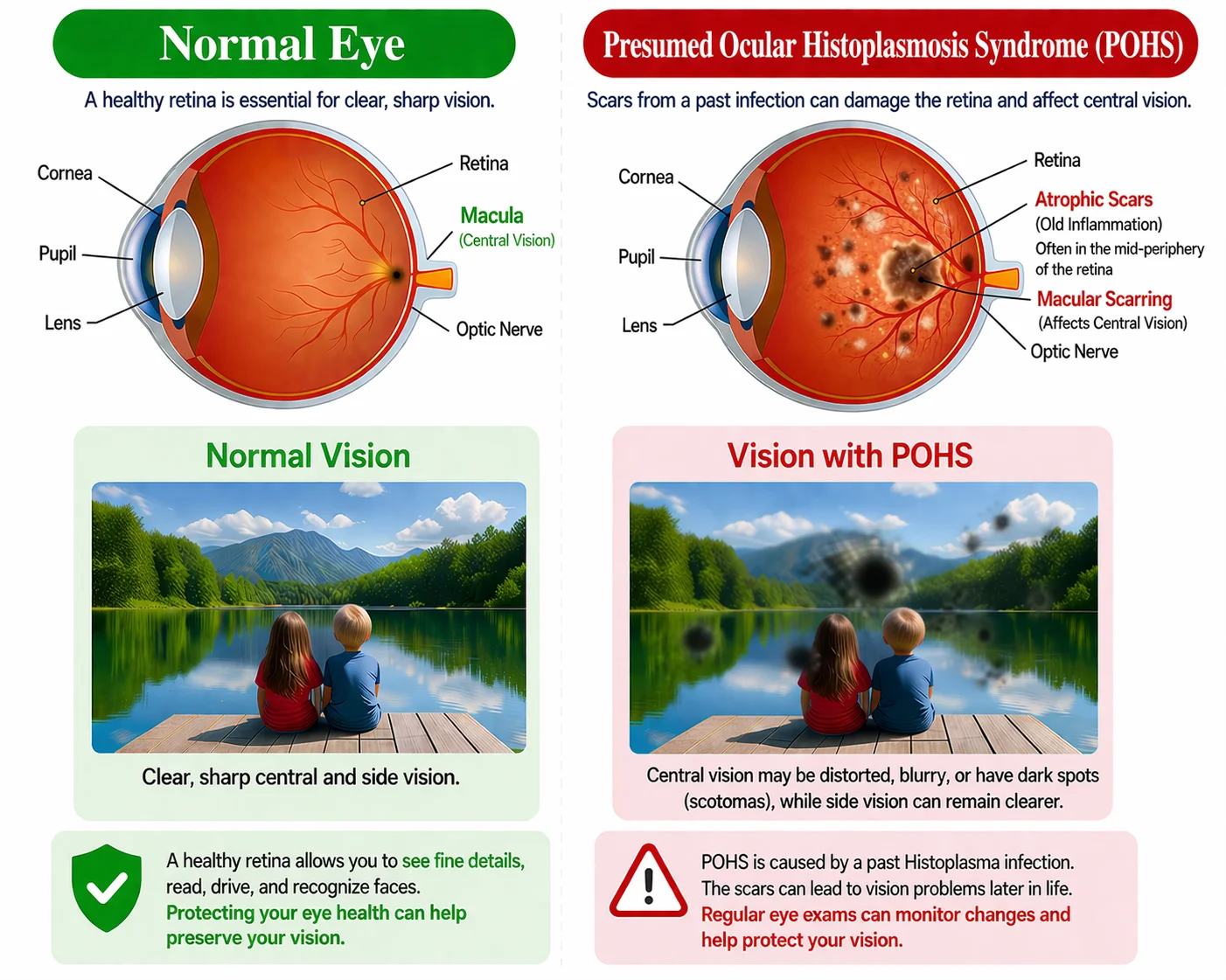
Learn more about Presumed Ocular Histoplasmosis Syndrome
Do I have Presumed Ocular Histoplasmosis Syndrome ?
POHS often causes no symptoms at first, which is why regular retinal exams matter when risk factors are present.
Symptoms of Presumed Ocular Histoplasmosis Syndrome
Symptoms can include, but are not limited to:
No early symptoms
Many patients with POHS do not notice any symptoms until central vision is affected.
Blind spot
A dark or missing area in central vision may develop if abnormal blood vessels affect the retina.
Wavy or crooked lines
Straight lines may begin to look bent, distorted, or irregular.
Treatment of Presumed Ocular Histoplasmosis Syndrome
Treatment depends on whether vision-threatening retinal changes are present:
Observation and monitoring
Many people with POHS do not need treatment unless abnormal blood vessels begin threatening vision.
Anti-VEGF injections
These medicines may help slow leaking blood vessels and can sometimes improve vision.
Laser or steroid treatment
Laser treatment or, in some cases, steroid injections may be used to help preserve vision.

Whether you need a routine eye exam, upadet glasses or contacts, or help with an eye concert, our fiendly team is here to make the process easy.
- Personalized Care
- States-f-the-Art Equipment
- Experienced Optometrists
- Family-Friendly Environment

What causes Presumed Ocular Histoplasmosis Syndrome?
POHS is associated with prior exposure to histoplasmosis, a fungal infection caused by breathing in spores from the environment. Histoplasma fungus is often found in soil contaminated by bird or bat droppings, and exposure is more common in parts of the central and eastern United States, especially around the Ohio and Mississippi River Valleys. Many people who were exposed never knew it happened. Even so, small retinal scars, sometimes called histo spots, can later be found on an eye exam. The exact pathway from lung exposure to retinal involvement is still not fully understood.
Getting a Diagnosis of Presumed Ocular Histoplasmosis Syndrome
POHS is typically diagnosed during a detailed retinal exam. Since many patients have no symptoms early on, the condition is often first identified when your eye doctor sees characteristic retinal changes during the dilated portion of your exam.
Common tests used to diagnose POHS include:
Dilated Eye Exam
Eye drops are used to enlarge the pupil so your doctor can carefully examine the retina and look for histo spots or abnormal blood vessel changes.
Fluorescein Angiography
This test uses a special dye injected into a vein in the arm so your doctor can photograph the retinal blood vessels and detect leakage or abnormal growth.
Central Vision Monitoring
Your doctor may recommend regular follow-up exams and, in some cases, home monitoring of central vision so new distortion can be caught early.
How Presumed Ocular Histoplasmosis Syndrome affects vision
POHS does not always affect vision right away, but when abnormal blood vessels grow beneath the retina, vision can change more quickly and more seriously.
- Quiet or inactive POHS may cause no noticeable symptoms and may only be found during a dilated retinal exam;
- Active retinal leakage may cause wavy lines, blurred central vision, or a blind spot when abnormal blood vessels begin leaking under the retina;
- Vision-threatening POHS can lead to more permanent central vision loss if treatment is delayed after new vessel growth begins.
Factors Increasing Risk of Presumed Ocular Histoplasmosis Syndrome
Anyone exposed to histoplasmosis may be at risk, but some groups appear more likely to develop POHS or its complications.
Common risk factors for POHS include:
- Living in or spending time in areas where histoplasma fungus is common
- Exposure to soil contaminated by bird or bat droppings
- Working around disturbed soil, fields, caves, or chicken coops
- Weakened immune system
- Older adults
- Infants or very young children
Questions about Presumed Ocular Histoplasmosis Syndrome?
We’re here to help you understand POHS clearly and protect your retinal health with careful monitoring and timely treatment when needed. Whether you have been diagnosed with ocular histoplasmosis, have lived in a high-risk area, or are noticing new distortion or blind spots in your vision, our team is happy to help you take the next step toward protecting your sight.
POHS is an eye condition linked to prior exposure to histoplasmosis. It can leave characteristic retinal scars and, in some cases, lead to abnormal blood vessel growth that threatens central vision.
Many people have no symptoms early on. When symptoms do happen, they may include a blind spot in vision, wavy or crooked-looking lines, or other changes in central vision.
Many patients do not need treatment unless vision-threatening abnormal blood vessels develop. Treatment may include anti-VEGF injections, retinal laser treatment, or sometimes steroid injections depending on the case.
If you are concerned about histoplasmosis exposure, it may help to avoid activities such as exploring caves, spending time around chicken coops, or disturbing soil contaminated by bird or bat droppings. Regular eye exams are important if you know you have been at risk.