Macular Hole
Learn about macular hole symptoms, causes, diagnosis, stages, and treatment options such as vitrectomy to help protect central vision.
Overview
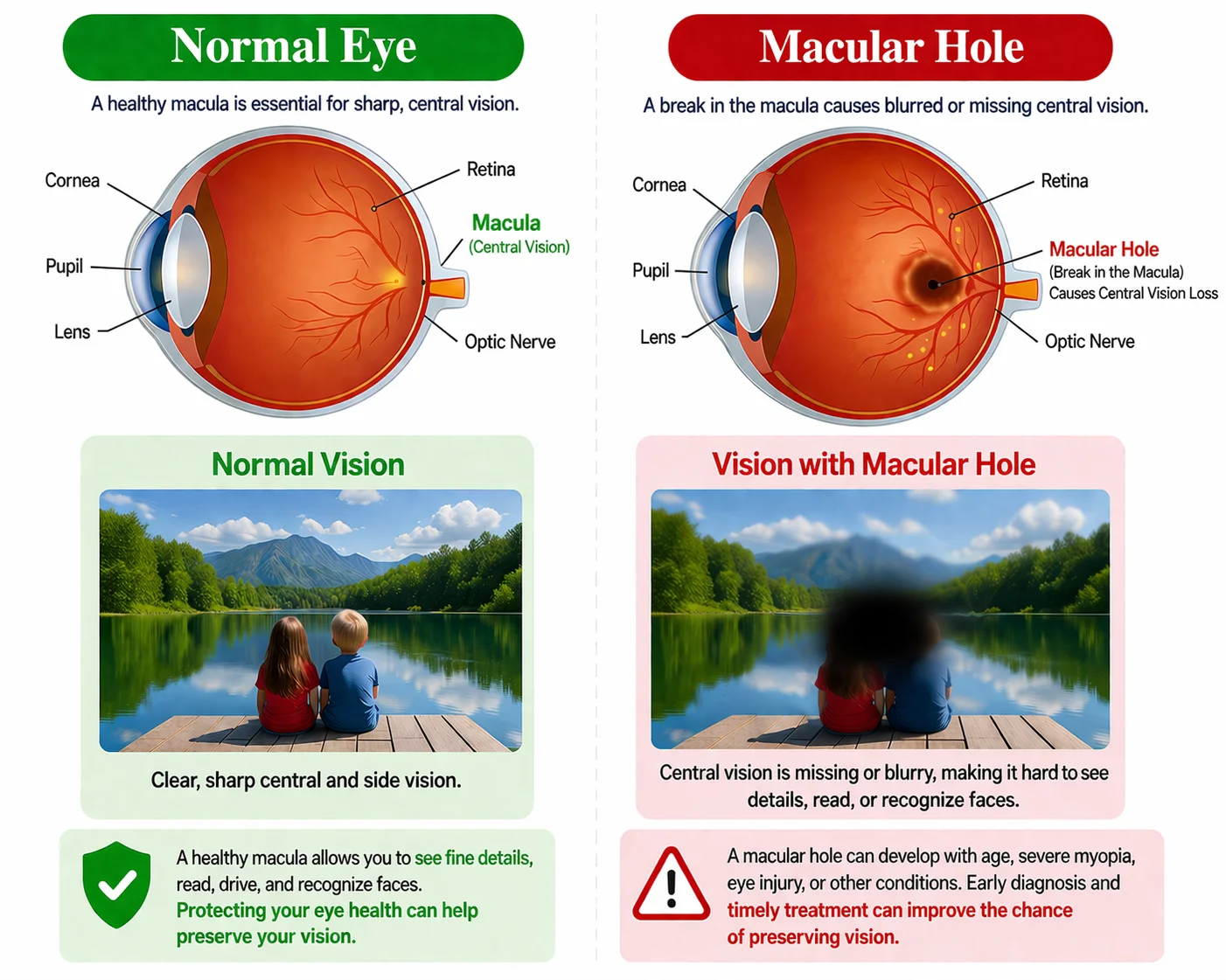
A macular hole is a small opening that develops in the macula, the part of the retina responsible for sharp, detailed central vision. More specifically, the hole forms in the fovea, the delicate center of the macula that helps you read, recognize faces, and see fine detail clearly. As the hole develops, central vision can become blurry, distorted, or increasingly difficult to use for everyday tasks. Macular holes are most common in older adults and often need prompt retinal evaluation to protect as much vision as possible.
Learn more about Macular Hole
Do I have Macular Hole ?
A macular hole usually affects central vision first, while side vision is generally preserved.
Symptoms of Macular Hole
Symptoms can include, but are not limited to:
Blurred central vision
You may notice a blurry spot or softer focus in the center of what you are looking at.
Distorted vision
Straight lines may begin to look bent or warped as the hole affects the fovea.
Progressive central vision loss
Over several weeks or months, central and detailed vision may worsen if the hole grows larger.
Treatment of Macular Hole
Treatment depends on the stage and severity of the hole:
Observation in select cases
Some macular holes may close on their own, so careful monitoring may be appropriate in limited situations.
Vitrectomy surgery
Most cases are treated with vitrectomy, which removes the vitreous gel and relieves traction on the macula.
Gas bubble support
A gas bubble is usually placed in the eye during surgery to help the hole close as the eye heals.

Whether you need a routine eye exam, upadet glasses or contacts, or help with an eye concert, our fiendly team is here to make the process easy.
- Personalized Care
- States-f-the-Art Equipment
- Experienced Optometrists
- Family-Friendly Environment

What causes Macular Hole?
Macular holes almost always develop as part of the natural aging process. As the vitreous gel inside the eye thins and separates from the macula, it can pull on this delicate area strongly enough to create a hole. Less commonly, macular holes may be associated with eye injury, intraocular inflammation, retinal detachment, nearsightedness, or macular pucker. Most cases occur in people over age 60.
Getting a Diagnosis of Macular Hole
A macular hole is diagnosed during a detailed retinal exam. Your eye doctor may use imaging and other retinal tests to confirm the diagnosis and determine how advanced the hole has become.
Common tests used to diagnose a macular hole include:
Dilated Eye Examination
Eye drops are used to widen the pupil so your doctor can examine the retina and look directly at the macula.
Optical Coherence Tomography (OCT)
OCT creates detailed cross-sectional images of the retina and helps show the size and depth of the hole.
Fluorescein Angiography
This test may also be used in some cases to evaluate the retina and rule out other problems affecting central vision.
Stages of Macular Hole
Macular holes are often described in stages based on how deep and advanced the defect has become.
- Stage 1 is a foveal detachment, when the earliest structural changes begin in the center of the macula;
- Stage 2 is a partial-thickness macular hole;
- Stage 3 is a full-thickness macular hole, when most detailed central vision may be lost if it is not treated.
Factors Increasing Risk of Macular Hole
Some people are more likely to develop a macular hole than others.
Common risk factors for a macular hole include:
- Age over 60
- Age-related vitreous separation
- Eye injury
- Intraocular inflammation
- Retinal detachment
- Nearsightedness
- Macular pucker
Questions about Macular Hole?
We’re here to help you understand macular holes clearly and guide you toward the treatment that best protects your central vision. Whether you are noticing blur, distortion, or have already been told you have a macular hole, our team is happy to help you take the next step toward preserving your sight.
A macular hole is a hole in the fovea, the delicate center of the macula that helps provide clear, sharp central vision. It can make reading, face recognition, and fine detail tasks more difficult.
Common symptoms include a small blurry or distorted area in the center of vision, followed by progressively worsening central vision over several weeks or months. Peripheral vision is usually not affected.
Some macular holes can resolve on their own, but in most cases surgery is required. Treatment usually involves vitrectomy with placement of a gas bubble to help the hole close while the eye heals.
Yes. If left untreated, a macular hole can progress and may increase the risk of a detached retina. Prompt evaluation is important when symptoms suggest a hole may be developing.