Macular Edema
Learn about macular edema, including symptoms, causes, diagnosis, and treatment options to help reduce retinal swelling and protect central vision.
Overview
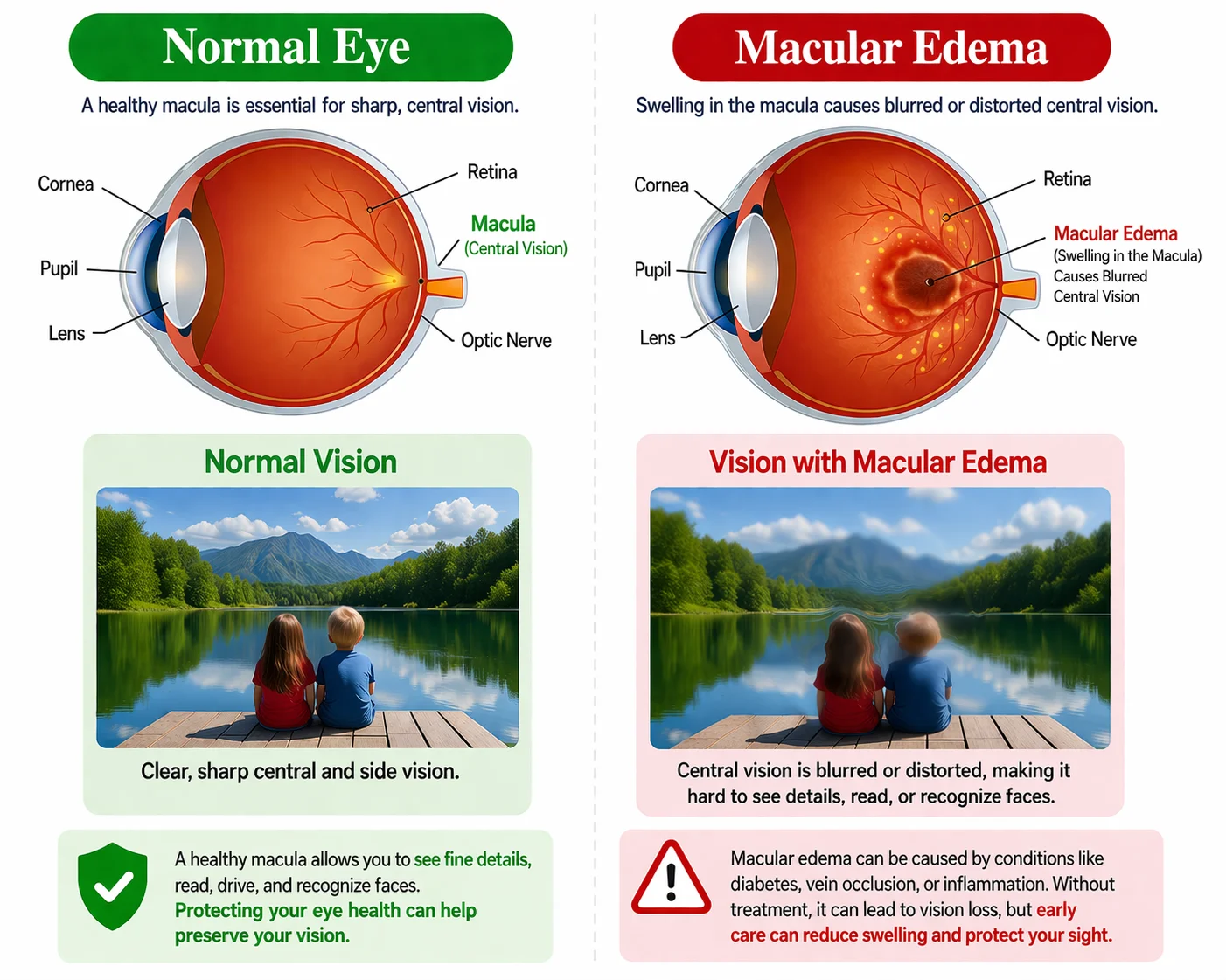
Macular edema is swelling in the macula, the part of the retina responsible for sharp central vision. When fluid leaks into the macula, the tissue swells and vision can become blurry, distorted, or less detailed. Some people notice only mild symptoms at first, while others have more significant trouble reading, driving, or seeing fine detail clearly. Macular edema is not a single disease by itself. Instead, it is usually a complication of another eye condition, so treatment often focuses on both reducing the swelling and addressing the underlying cause.
Learn more about Macular Edema
Do I have Macular Edema ?
Macular edema affects central vision, so symptoms often show up when reading, driving, or looking at straight lines.
Symptoms of Macular Edema
Symptoms can include, but are not limited to:
Blurry vision
Central vision may look soft or less clear and can worsen over time.
Wavy or distorted vision
Objects or lines may appear bent, warped, or irregular when looking straight ahead.
Dull color vision or central vision loss
Colors may seem faded, and some people develop more significant central vision problems.
Treatment of Macular Edema
Treatment depends on the cause of the swelling and how severe it has become:
Eye drops or injections
Depending on the cause, your doctor may recommend anti-inflammatory drops, anti-VEGF injections, or steroid treatment.
Laser treatment
Laser may be used for some types of macular edema, especially when leakage from abnormal blood vessels needs to be reduced.
Vitrectomy surgery
If other treatments do not help or if the cause involves traction or other retinal complications, surgery may be recommended.

Whether you need a routine eye exam, upadet glasses or contacts, or help with an eye concert, our fiendly team is here to make the process easy.
- Personalized Care
- States-f-the-Art Equipment
- Experienced Optometrists
- Family-Friendly Environment

What causes Macular Edema?
Macular edema happens when blood vessels leak into the macula and make it swell. The most common cause is diabetic retinopathy, but it can also happen with wet macular degeneration, retinal vein occlusion, uveitis, retinitis pigmentosa, after some types of eye surgery, or as a side effect of certain medications. Because macular edema is usually a complication of another condition, finding the underlying cause is an important part of treatment planning.
Getting a Diagnosis of Macular Edema
Macular edema is usually diagnosed during a dilated eye exam and confirmed with retinal imaging. Your eye doctor may use several tests to measure swelling and determine what is causing it.
Common tests used to diagnose macular edema include:
Dilated Eye Exam
This simple exam lets your doctor look directly at the retina and check for swelling in the macula.
Optical Coherence Tomography (OCT)
OCT creates detailed pictures of the retina and helps show how much swelling is present.
Fluorescein Angiogram or Amsler Grid
Additional testing may be used to look for leaking blood vessels or to check whether central vision is becoming distorted or missing in certain areas.
Common causes of Macular Edema
Macular edema is not one single disease. It is usually a sign that another eye condition is causing fluid to build up in the macula.
- Diabetic macular edema is the most common form and happens when diabetic retinopathy causes leaking blood vessels in the retina;
- Retinal vein occlusion-related macular edema develops when blocked retinal veins cause swelling in the macula;
- Inflammatory or post-surgical macular edema can happen with uveitis or after eye surgery, including cataract surgery;
- Macular edema from other retinal disease may occur with wet AMD, retinitis pigmentosa, or certain medication-related side effects.
Factors Increasing Risk of Macular Edema
Because macular edema is usually caused by another eye or health problem, risk factors often depend on the underlying condition.
Common risk factors can include:
- Diabetes and diabetic retinopathy
- Retinal vein occlusion
- Wet macular degeneration
- Inflammation inside the eye, such as uveitis
- Recent eye surgery
- Certain medications that can cause retinal swelling as a side effect
Questions about Macular Edema?
We’re here to help you understand why the macula is swelling and what can be done to protect your vision. Whether you are dealing with diabetic eye disease, retinal vein problems, post-surgical swelling, or another cause of macular edema, our team is happy to help guide you toward the right next step.
Macular edema is swelling in the macula caused by fluid leaking into this part of the retina. Because the macula controls sharp central vision, swelling can make vision blurry, distorted, and less detailed.
The most common symptoms are blurry vision and vision that gradually gets worse. Some people also notice wavy vision, faded colors, or differences in how objects look from one eye to the other.
Macular edema happens when retinal blood vessels leak into the macula. The most common cause is diabetic retinopathy, but it can also happen with retinal vein occlusion, wet macular degeneration, uveitis, after eye surgery, or from certain medications.
Treatment depends on the cause and may include eye drops, injections, laser treatment, or vitrectomy surgery. Your doctor may also treat the underlying condition, such as diabetes or retinal vein disease, to help control the swelling.