Epiretinal Membranes/Pucker
Learn about epiretinal membrane, including macular pucker symptoms, causes, diagnosis, and when vitrectomy treatment may be recommended.
Overview
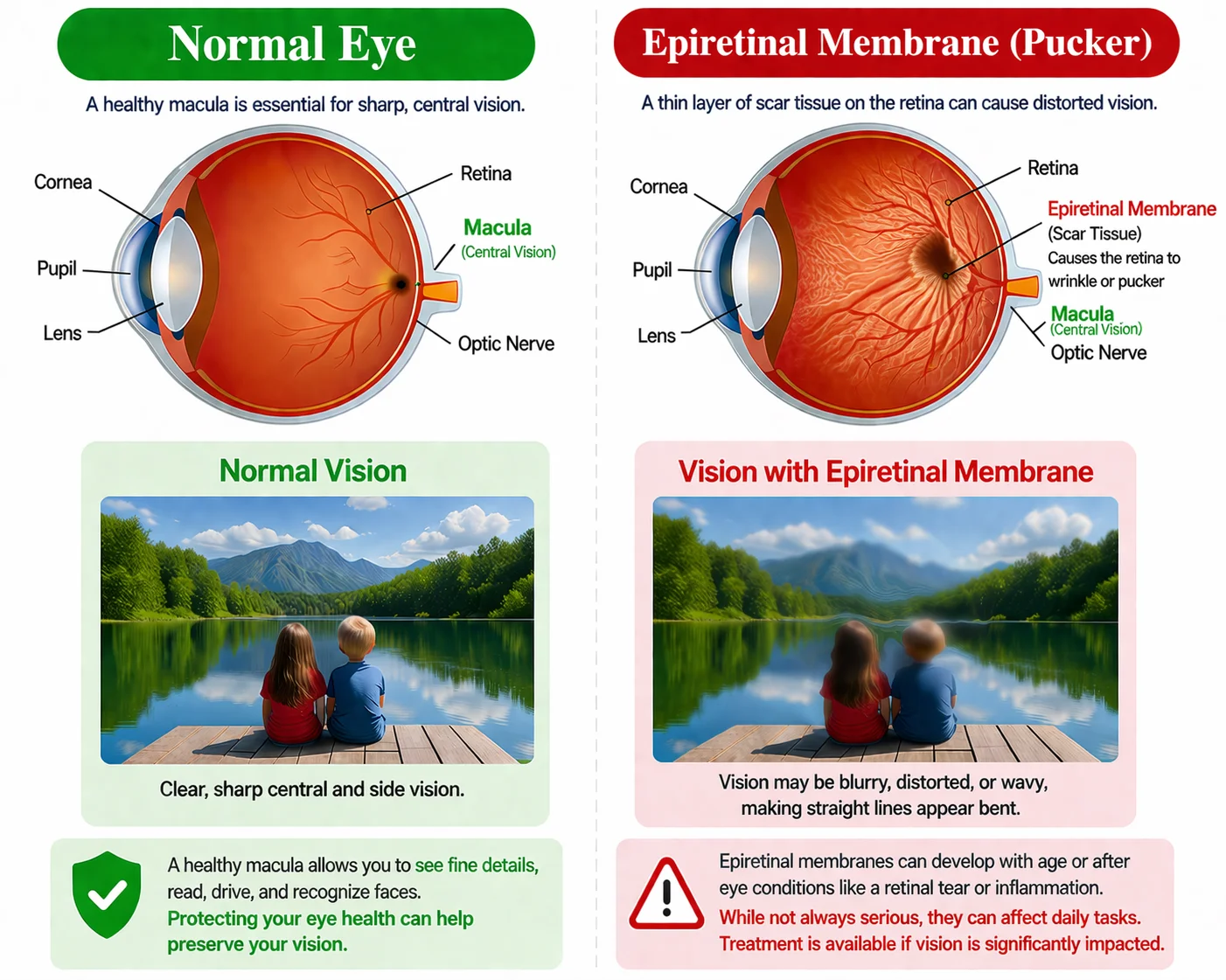
An epiretinal membrane, also called a macular pucker, is a thin layer of scar tissue that forms over the macula, the part of the retina responsible for clear, sharp central vision. When this delicate tissue contracts, it can wrinkle or pucker the retina and make central vision look blurry or distorted. Some people notice only mild symptoms, while others find that reading, fine detail work, and other everyday tasks become more difficult. In many cases, an epiretinal membrane stays mild and stable, but if distortion becomes severe, treatment may be recommended to improve vision.
Learn more about Epiretinal Membranes/Pucker
Do I have Epiretinal Membranes/Pucker ?
A macular pucker can affect central vision gradually, and many patients first notice trouble with detail or distortion rather than pain.
Symptoms of Epiretinal Membranes/Pucker
Symptoms can include, but are not limited to:
Blurred central vision
Objects in the center of vision may look less sharp or more difficult to focus on clearly.
Wavy or distorted lines
Straight lines may appear bent, crooked, or rippled because the retina is being wrinkled.
Trouble with fine detail or a gray central spot
Reading small print, seeing detail, or noticing a faint gray area in central vision may become more difficult.
Treatment of Epiretinal Membranes/Pucker
Treatment depends on how much the membrane is affecting daily vision:
Monitoring without treatment
Most epiretinal membranes do not progress significantly and can simply be watched over time.
Adjusting to mild distortion
When symptoms are mild, many patients adapt well and do not need immediate intervention.
Vitrectomy surgery
If distortion becomes severe enough to interfere with vision, surgery may be performed to repair the condition.

Whether you need a routine eye exam, upadet glasses or contacts, or help with an eye concert, our fiendly team is here to make the process easy.
- Personalized Care
- States-f-the-Art Equipment
- Experienced Optometrists
- Family-Friendly Environment

What causes Epiretinal Membranes/Pucker?
An epiretinal membrane often develops as part of the normal aging process. As the vitreous gel inside the eye thins and begins to pull away from the retina, small areas of damage can occur on the retinal surface. That irritation can lead to the formation of scar tissue. When the scar tissue contracts, it can wrinkle or pucker the retina and distort central vision. Although aging is the most common cause, similar retinal surface changes can also happen after other retinal problems or eye conditions.
Getting a Diagnosis of Epiretinal Membranes/Pucker
An epiretinal membrane is diagnosed during a thorough eye exam. After examining the retina, your doctor may perform imaging and other tests to measure how much the membrane is affecting the macula and central vision.
Common tests used to diagnose an epiretinal membrane include:
Dilated Eye Examination
Eye drops are used to widen the pupil so your doctor can examine the retina and look directly at the macula.
Fluorescein Angiography
This test may be used to evaluate retinal circulation and detect other retinal changes that may be affecting vision.
Optical Coherence Tomography (OCT)
OCT creates detailed cross-sectional images of the retina and helps show the extent of wrinkling or pulling at the macula.
How Epiretinal Membranes/Pucker affects vision
An epiretinal membrane can affect vision in different ways depending on how much the scar tissue is pulling on the macula.
- Mild membrane may cause only subtle blur or minor distortion that does not interfere much with daily activities;
- Moderate membrane may make reading, fine detail work, and straight lines noticeably more difficult;
- Severe macular pucker can create more significant distortion, blurry central vision, and a gray or blind spot that affects daily function.
Factors Increasing Risk of Epiretinal Membranes/Pucker
An epiretinal membrane most often develops as people get older, but other retinal conditions can also increase the risk.
Common risk factors for an epiretinal membrane include:
- Increasing age
- Age-related vitreous changes
- Previous retinal irritation or damage
- Other retinal conditions that affect the macula
- Changes in the vitreous pulling on the retina
Questions about Epiretinal Membranes/Pucker?
We’re here to help you understand macular pucker clearly and determine whether your vision changes need monitoring or treatment. Whether you are noticing wavy lines, central blur, or trouble with fine detail, our team is happy to help you take the next step toward protecting your sight.
An epiretinal membrane, also called a macular pucker, is a thin layer of scar tissue that forms over the macula. When it tightens, it can wrinkle the retina and distort central vision.
Common symptoms include blurred central vision, difficulty seeing fine detail, trouble reading small print, wavy straight lines, and sometimes a gray area or blind spot in the center of vision.
No. Most cases do not progress significantly and do not require treatment. Many patients adjust well when symptoms are mild and daily activities are not heavily affected.
Eye drops and medications do not improve the distortion caused by an epiretinal membrane. If vision distortion becomes severe enough, a vitrectomy may be performed to repair the condition.