Macular Degeneration
Learn about macular degeneration, including symptoms, dry and wet AMD, diagnosis, risk factors, and treatment options to help preserve central vision.
Overview
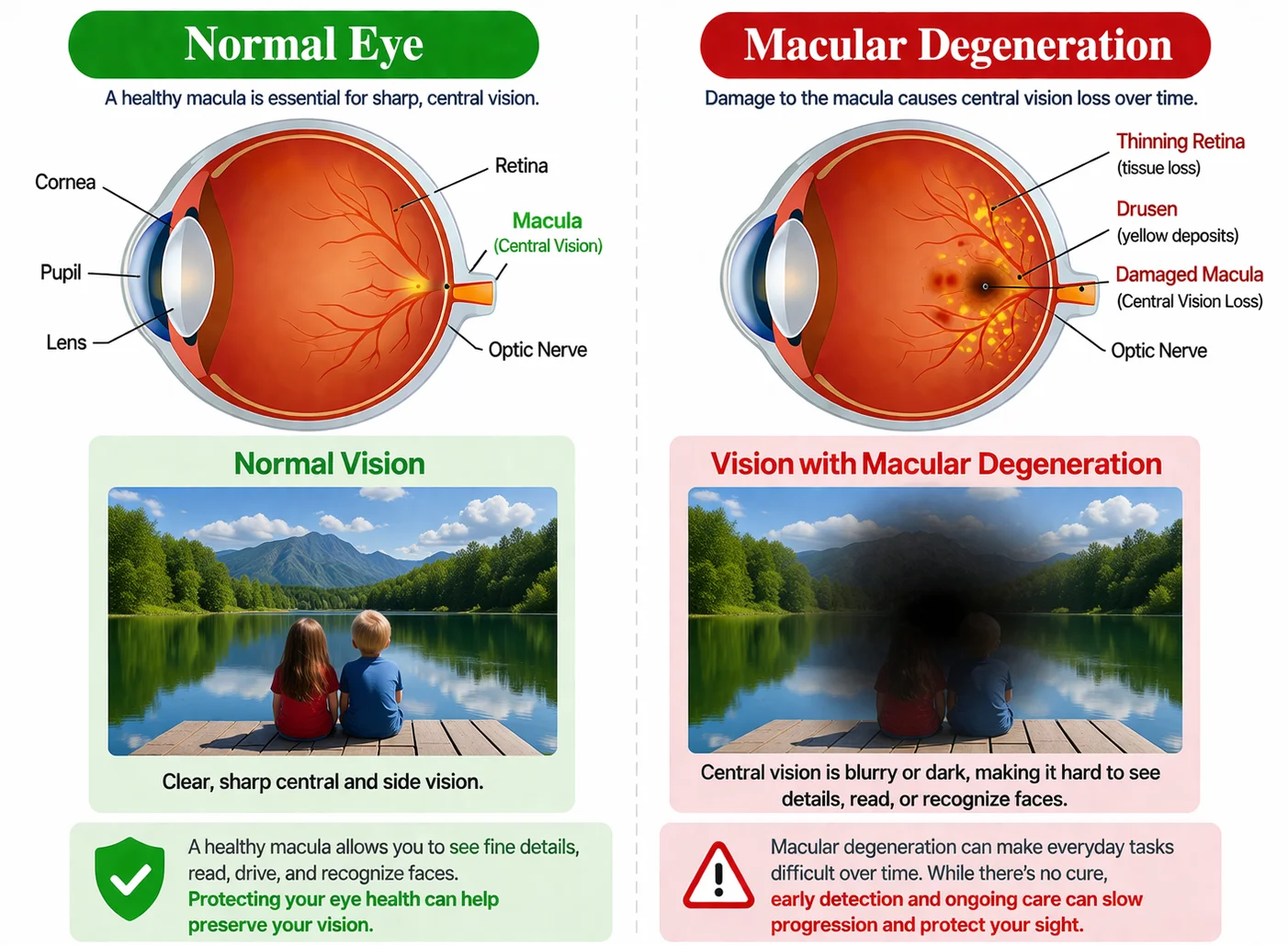
Macular degeneration, also called age-related macular degeneration or AMD, is a condition that affects the macula, the part of the retina responsible for the sharp central vision needed for reading, driving, and recognizing faces. It is most common in older adults and can gradually reduce the clarity and detail of central vision over time. AMD does not usually affect peripheral vision, so people often keep their side vision even as the center becomes more distorted or blurry. Early detection is important because some forms of macular degeneration can be monitored closely, while others need prompt treatment to help preserve vision.
Learn more about Macular Degeneration
Do I have Macular Degeneration ?
Macular degeneration often affects central vision first, while side vision is usually preserved.
Symptoms of Macular Degeneration
Symptoms can include, but are not limited to:
Blurred or distorted central vision
Vision in the center may begin to look fuzzy, warped, or less detailed.
Shadowy areas or blind spots
You may notice missing or darkened areas in central vision.
Difficulty with fine detail or straight lines
Reading small print, recognizing faces, or seeing straight lines clearly may become harder.
Treatment of Macular Degeneration
Treatment depends on whether AMD is dry or wet and how advanced it has become:
Monitoring and regular exams
Early or dry macular degeneration is often followed closely to watch for progression and protect remaining vision.
Anti-VEGF injections
Wet AMD is often treated with medication injections to help stop abnormal blood vessel growth and leakage.
Photodynamic therapy and supplements
Some patients benefit from other supportive treatment options depending on the type and severity of disease.

Whether you need a routine eye exam, upadet glasses or contacts, or help with an eye concert, our fiendly team is here to make the process easy.
- Personalized Care
- States-f-the-Art Equipment
- Experienced Optometrists
- Family-Friendly Environment

What causes Macular Degeneration?
Macular degeneration is usually related to aging changes in the macula. In dry AMD, the tissues of the macula gradually thin over time, and pigment or other deposits can develop. In some patients, the disease progresses to the more advanced wet form, in which abnormal blood vessels grow beneath the macula and leak blood or fluid. That leakage can damage central vision more rapidly and may lead to permanent blind spots if not treated promptly.
Getting a Diagnosis of Macular Degeneration
Macular degeneration is often diagnosed during a routine eye exam before symptoms become severe. Your eye doctor can look for early retinal changes and may use additional testing to evaluate how central vision is being affected.
Common tests used to diagnose macular degeneration include:
Dilated Eye Exam
A regular eye examination may reveal early signs of macular degeneration even before the patient notices symptoms.
Amsler Grid Test
This test checks central vision and can help reveal distortion, missing areas, or waviness in the visual field.
Central Retinal Evaluation
Your doctor may recommend ongoing retinal monitoring to determine whether the condition is stable, progressing, or changing from dry to wet AMD.
Different types of Macular Degeneration
Macular degeneration is generally classified into two main forms, and understanding the difference helps guide monitoring and treatment.
- Dry macular degeneration is the more common form and is usually considered the earlier stage of the disease;
- Wet macular degeneration is the more advanced form, when abnormal blood vessels grow beneath the macula and leak fluid or blood;
- Dry-to-wet progression is important to watch for because vision loss can become much faster once wet AMD develops.
Factors Increasing Risk of Macular Degeneration
As people get older, everyone carries some risk for macular degeneration, but certain genetic and environmental factors may raise that risk more than others.
Common risk factors for macular degeneration include:
- Increasing age
- Family history or genetic risk factors
- Female sex
- Light skin or light eye color
- Smoking
- Obesity
- High-fat diet
- Elevated cholesterol
- High blood pressure
- Prolonged sun exposure
Questions about Macular Degeneration?
We’re here to help you understand macular degeneration clearly and protect as much central vision as possible through careful monitoring and timely treatment. Whether you have early AMD, new visual distortion, or have already been diagnosed with wet macular degeneration, our team is happy to help you take the next step toward preserving your sight.
Macular degeneration, or AMD, is an age-related eye condition that affects the macula, the part of the retina responsible for sharp central vision. It can make reading, driving, and recognizing faces more difficult over time.
Common symptoms include fuzzy or distorted central vision, difficulty seeing fine detail, blind spots or shadowy areas in central vision, and in wet AMD, straight lines that begin to look wavy or crooked.
Dry macular degeneration is the more common form and usually develops more gradually. Wet macular degeneration is more advanced and happens when abnormal blood vessels grow beneath the macula and leak fluid or blood, which can cause faster central vision loss.
There is no cure for macular degeneration, but treatment can help preserve vision. Wet AMD is often treated with anti-VEGF injections, and some patients may also benefit from photodynamic therapy or vitamin and mineral supplements depending on the type and stage of disease.