Aphakia
Learn about aphakia, including symptoms, causes, diagnosis, and treatment options such as glasses, contact lenses, and lens-based correction.
Overview
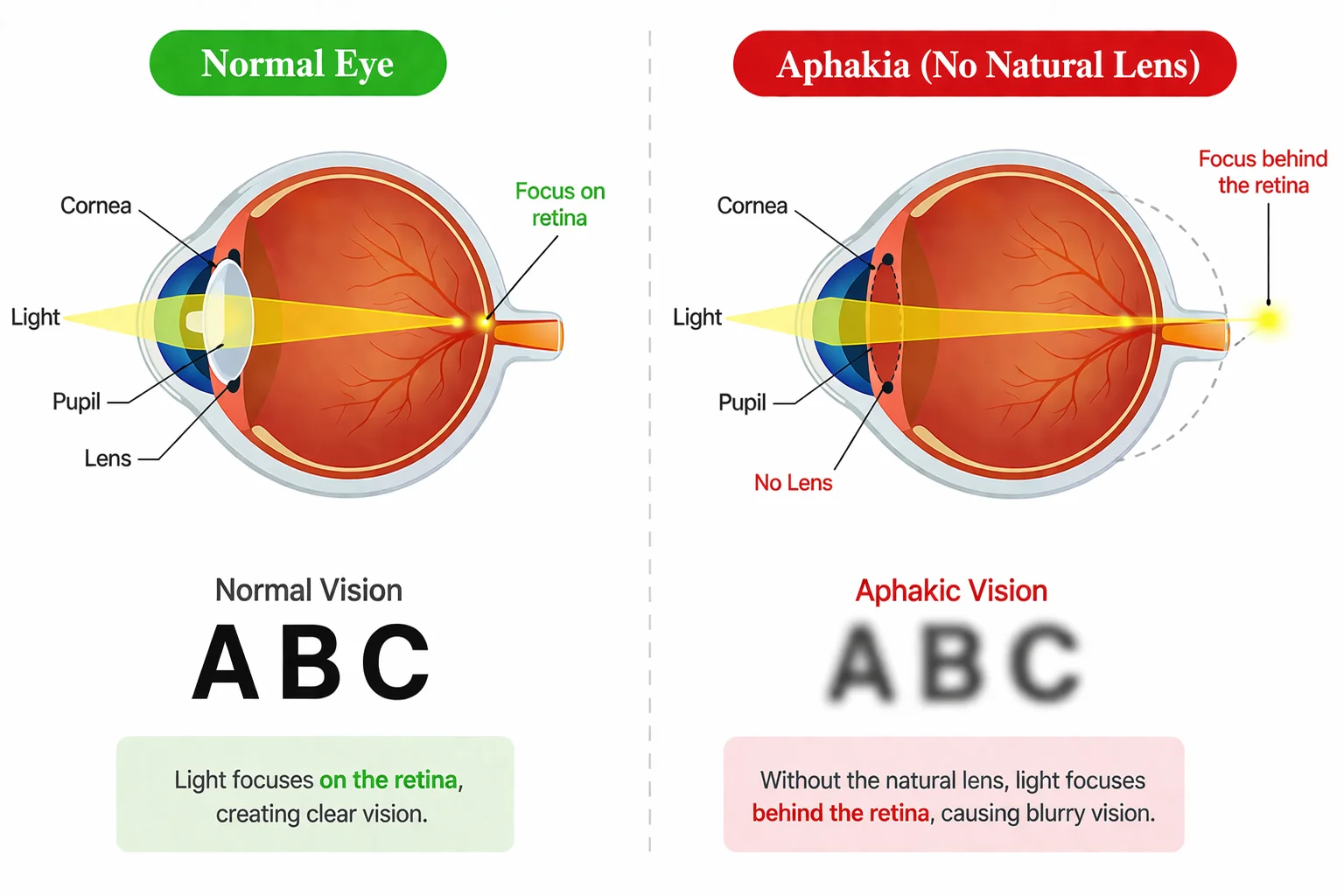
Aphakia is an eye condition in which the natural lens is missing from one or both eyes. The lens normally sits behind the iris and pupil and helps focus incoming light onto the retina. When the lens is absent, vision can become significantly blurry and focusing may be difficult at multiple distances. Aphakia most often happens after cataract surgery or eye trauma, but in rare cases a person can be born without a fully developed lens. Treatment depends on the cause, the age of the patient, and the best way to restore useful vision as clearly and comfortably as possible.
Learn more about Aphakia
Do I have Aphakia ?
Aphakia affects the way light is focused in the eye, so vision may be blurry and less stable at more than one distance.
Symptoms of Aphakia
Symptoms can include, but are not limited to:
Blurred vision
Vision may be blurry in one or both eyes because the eye no longer has its natural focusing lens.
Difficulty seeing near and far
Without the natural lens, it can be hard to focus clearly at multiple distances.
Faded colors or depth perception problems
Some people notice washed-out colors, trouble judging distance, or a jiggling iris.
Treatment of Aphakia
Treatment can include, but is not limited to:
Glasses
Special aphakia glasses may help some patients, especially when both eyes are affected.
Contact lenses
High-powered contact lenses are often used to improve focusing and may be especially helpful in younger patients.
Lens-based correction
Some patients may be treated with an intraocular lens approach depending on the cause and overall treatment plan.

Whether you need a routine eye exam, upadet glasses or contacts, or help with an eye concert, our fiendly team is here to make the process easy.
- Personalized Care
- States-f-the-Art Equipment
- Experienced Optometrists
- Family-Friendly Environment

What causes Aphakia?
There are several possible causes of aphakia. The most common is cataract surgery, when the natural lens is removed. Aphakia can also happen after a serious eye injury that damages or dislodges the lens. In rare cases, a baby may be born without a normal lens, a condition known as congenital aphakia. Understanding the cause is important because treatment and long-term management may be different for adults, children, and patients with other eye conditions.
Getting a Diagnosis of Aphakia
Aphakia is usually diagnosed during a comprehensive eye exam. Your eye doctor will review your medical and eye history, including any prior surgery or injury, and examine the structures inside the eye to confirm that the natural lens is absent.
Common parts of the diagnostic process include:
Medical and Eye History
Your doctor will ask about previous cataract surgery, eye trauma, congenital eye issues, and any vision changes you have noticed.
Slit Lamp Examination
A slit lamp allows your eye doctor to closely examine the eye with magnification and confirm whether the natural lens is missing.
Comprehensive Eye Exam
A full exam helps evaluate overall eye health, determine how aphakia is affecting your vision, and guide the most appropriate treatment options.
Different types of Aphakia
Aphakia may be described by its cause, since that often shapes treatment and long-term care.
- Post-surgical aphakia most commonly occurs after cataract surgery when the natural lens has been removed;
- Traumatic aphakia happens when an eye injury causes the loss or severe damage of the lens;
- Congenital aphakia is present at birth and may occur when the lens never fully develops;
- Primary congenital aphakia means the lens never develops at all;
- Secondary congenital aphakia means the lens begins to develop but does not fully form.
Factors Increasing Risk of Aphakia
Aphakia is not usually thought of as a condition that develops gradually on its own, but certain situations make it more likely to occur.
Common factors associated with aphakia include:
- Previous cataract surgery
- Serious eye injury or trauma
- Congenital eye development problems
- Childhood cases that require long-term vision management
- Associated eye conditions that affect lens development or eye structure
Questions about Aphakia?
We’re here to help you understand aphakia clearly and find the treatment option that makes the most sense for your vision and your life. Whether your aphakia followed surgery, injury, or began early in life, our team is happy to help you take the next step toward clearer, more functional vision.
Aphakia is a condition in which the natural lens is missing from one or both eyes. Because the lens helps focus light, its absence can cause significant blur and focusing problems.
The most common causes are cataract surgery, eye trauma, and rare congenital conditions in which the lens never fully develops. The treatment approach often depends on the cause and the age of the patient.
Aphakia may be treated with special glasses, high-powered contact lenses, or lens-based correction depending on the situation. Your eye doctor will recommend the best option based on your vision needs and overall eye health.
Aphakia means the eye does not have a natural lens. Pseudophakia means the natural lens has been removed and replaced with an artificial intraocular lens, which is common after cataract surgery.