Lens Options
Explore cataract lens options, including monofocal, toric, multifocal, and other IOL choices designed to match your vision needs after cataract surgery.
Overview
During cataract surgery, the eye’s natural lens is removed and replaced with an intraocular lens, also called an IOL. This lens becomes a permanent part of the eye and plays a major role in how clearly you see after surgery. Some lens options are designed to give you crisp distance vision, while others may help reduce your dependence on glasses for reading, computer use, or astigmatism. Choosing the right lens depends on your eyes, your daily activities, and your visual goals, which is why lens planning is such an important part of the cataract surgery process.
Learn more about Lens Options
Which Lens Options are right for me?
The right lens choice depends on what you want to see clearly after cataract surgery and how much you want to rely on glasses.
Lens goals after cataract surgery
Common vision goals can include:
Clear distance vision
Many patients want to drive, watch TV, and enjoy events with less dependence on glasses.
Less dependence on reading glasses
Some lens choices are designed to improve near or intermediate vision for reading and computer use.
Correction for astigmatism
If you have astigmatism, certain premium lens options may help sharpen vision more effectively.
Types of lens options
Lens choices can include:
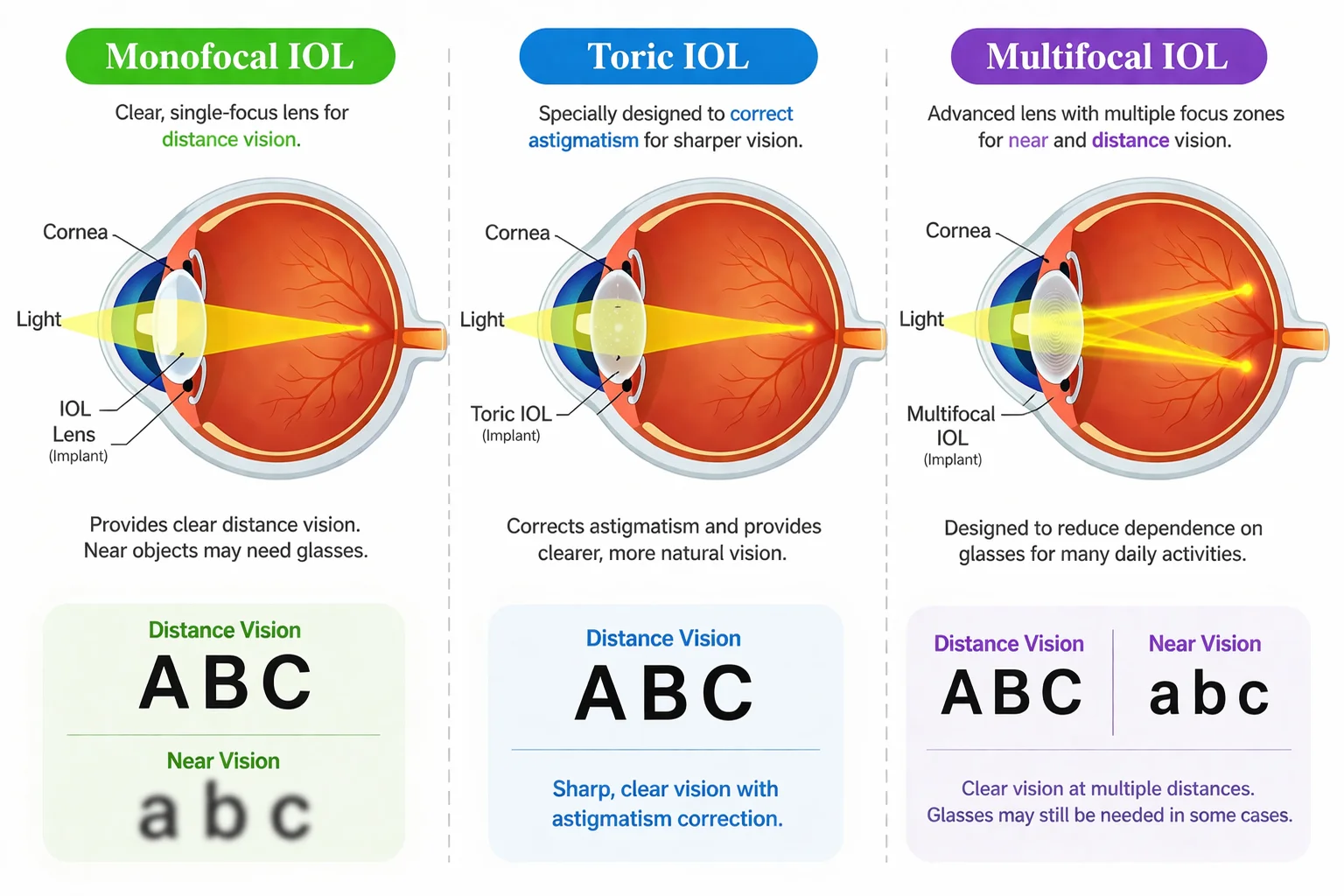
Monofocal IOLs
These standard lenses usually correct one focal range, often distance, so reading glasses are still commonly needed.
Toric IOLs
Toric lenses are designed to correct astigmatism and can improve the quality of distance vision.
Multifocal or accommodating IOLs
These premium options may expand your range of vision and reduce your need for glasses at more than one distance.

Whether you need a routine eye exam, upadet glasses or contacts, or help with an eye concert, our fiendly team is here to make the process easy.
- Personalized Care
- States-f-the-Art Equipment
- Experienced Optometrists
- Family-Friendly Environment

What are intraocular lenses?
Intraocular lenses, or IOLs, are small medical devices implanted inside the eye during cataract surgery to replace the cloudy natural lens. They are designed to restore focus after the cataract is removed. Standard monofocal lenses are the most basic option and usually provide clear vision at one distance. Premium lens options can offer additional features such as astigmatism correction or a broader range of vision for everyday activities like reading, computer work, and distance viewing.
Choosing your Lens Options
Choosing the right lens is an important part of cataract surgery planning. During your evaluation, your eye doctor will take measurements of your eyes, review your prescription and any astigmatism, and talk with you about how you use your vision every day.
Common parts of the lens selection process include:
Cataract Evaluation
Your doctor will examine the health of your eyes, confirm that cataract surgery is appropriate, and review any other eye conditions that may affect your result.
Eye Measurements
Detailed measurements help calculate lens power, assess astigmatism, and determine which IOL options may work best for your eyes.
Lifestyle Discussion
Your surgeon will talk with you about your priorities, such as driving, reading, sports, computer use, and how much you want to depend on glasses after surgery.
Different types of Lens Options
Different IOL designs are available to match different visual needs. The best choice depends on your prescription, any astigmatism, and what matters most to you after surgery.
- Monofocal IOLs are the standard lens option and usually correct one range of vision, often distance, so reading glasses are commonly still needed;
- Toric IOLs are premium lenses designed to correct astigmatism and improve the clarity of distance vision;
- Accommodating IOLs are designed to provide good distance vision and may improve functional intermediate or some near vision;
- Multifocal IOLs use different zones of the lens to expand range of vision at multiple distances and may reduce dependence on reading glasses;
- Blended lens strategies may use a different type of IOL in each eye when that combination offers the best overall visual result.
Factors that influence Lens Options
Not every lens option is the best fit for every patient. Your surgeon will look at both your eyes and your goals to recommend the lens option most likely to give you the kind of vision you want.
Factors that often influence lens selection include:
- Your desire for distance, intermediate, or near vision after surgery
- Whether you have astigmatism
- How important it is to reduce dependence on glasses
- Your comfort with night driving, glare, and contrast sensitivity tradeoffs
- Your work, hobbies, sports, and computer use
- Other eye conditions that may affect visual results
- Insurance coverage and any out-of-pocket costs for premium options
Questions about Lens Options?
We’re here to help you understand your cataract lens choices clearly and confidently. Whether you want the simplest option, need astigmatism correction, or hope to reduce your dependence on glasses after surgery, our team is happy to walk you through your choices and help you decide what fits your life best.
Intraocular lenses, or IOLs, are artificial lenses placed inside the eye during cataract surgery to replace the eye’s cloudy natural lens. They are designed to restore focus after the cataract is removed.
It depends on the type of lens chosen and your visual goals. Standard monofocal lenses often provide clear vision at one distance, so many patients still need glasses for reading or close work. Some premium lens options may reduce dependence on glasses at more than one distance.
Premium IOLs are advanced lens options designed to do more than a standard monofocal lens. Depending on the lens, they may correct astigmatism, improve intermediate vision, or broaden your range of vision to reduce dependence on glasses after surgery.
Yes. In some cases, the best visual outcome may involve using a different type of IOL in each eye. For example, one eye may benefit from astigmatism correction while the other may be better suited for a different lens design. Your surgeon can explain whether a blended approach makes sense for you.